
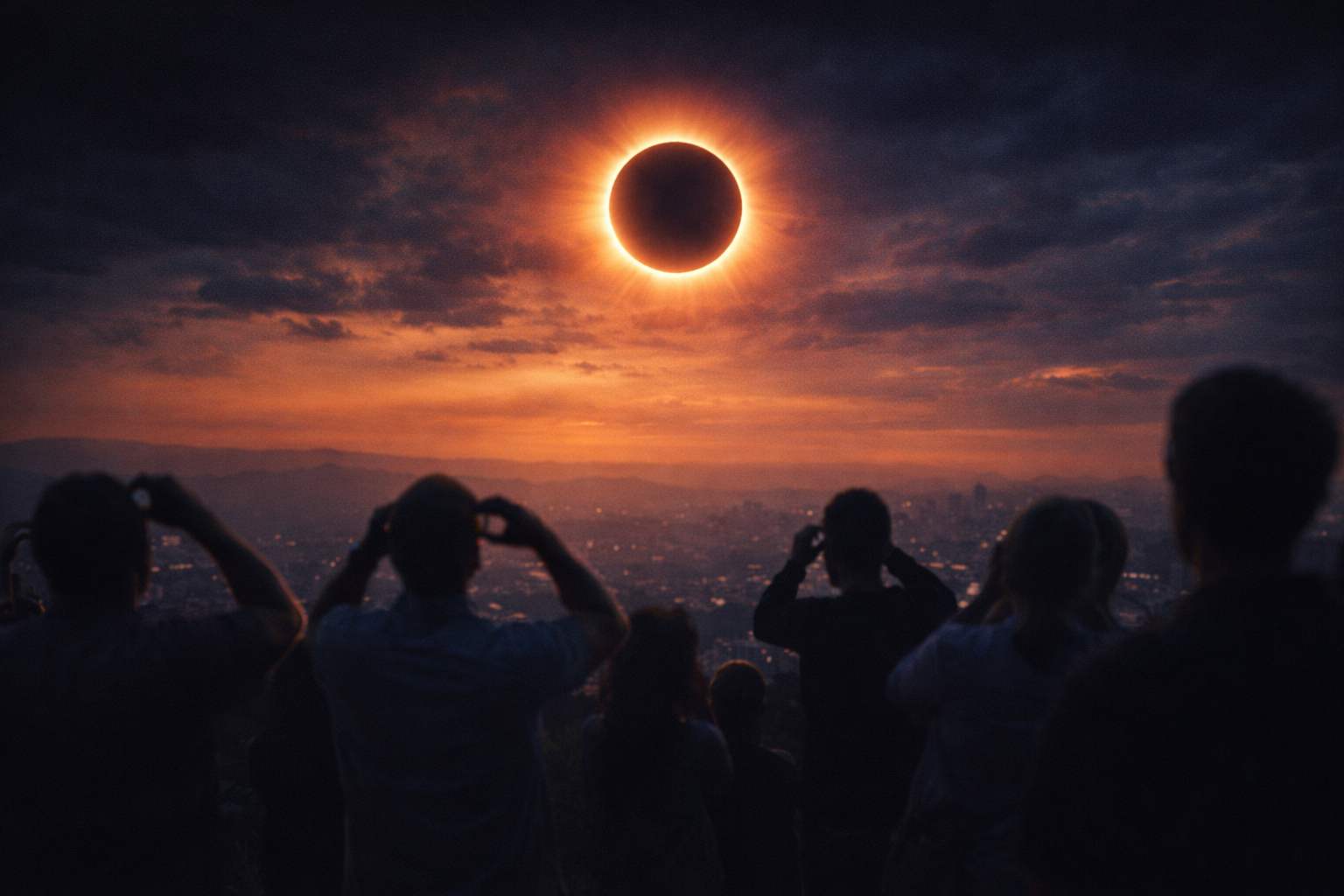
6 minutes of darkness: get ready for the longest eclipse of the century that will turn day into night

Nobody notices the sun shrinking at first. On sidewalks, people scroll through phones. Cars move through intersections under that flat, ordinary midmorning light. Then someone glances up, squints, and points. A sliver is missing. Another voice says, half-joking, “Is this the apocalypse?” and suddenly necks crane, conversations freeze, the city holds its breath.
Within minutes, daylight feels wrong. Sharper. Colder. Shadows split into doubles like a video glitch. Stray dogs stop barking. Birds grow restless. Shop lights flick on at 10 a.m. for no reason except pure instinct.
Six minutes. That’s how long the sun will disappear this time. Not a blink. Not a brief fade. Six full minutes of darkness in the middle of a weekday, stretching across parts of the continent with an intensity that hasn’t happened in a century.
The geometry of an unforgettable six minutes
A total solar eclipse is rare enough to rearrange an entire day. This one carries an extra weight. Astronomers have quietly noted what they call the longest eclipse of the century, a period of totality stretching close to six minutes in certain locations. That’s not a gasp of darkness followed by quick relief. That’s time to feel your skin chill, watch the world shift color, ask yourself why your body is responding to something your brain insists is “just astronomy.”
Streetlights flicker on in broad daylight. Temperatures can drop several degrees within seconds. Birds behave as if sunset has arrived hours early. People who genuinely don’t care about space will find themselves standing outside, staring upward, forgetting meetings and schedules. For a few minutes, the sky owns every conversation on Earth.
Ask anyone who witnessed the 2017 eclipse across the United States, the 1999 event in Europe, or the 2024 eclipse path across North America. They’ll describe the quiet first, before explaining the science. A hush settles over crowds. Windows slide open in office towers. Children gasp on playgrounds. According to NASA eclipse records, witness accounts consistently emphasize the emotional experience before any technical detail. In a small Kentucky town during 2017, traffic stopped completely on the interstate as strangers climbed from cars to share eclipse glasses like precious tickets.
The science remains the same: the moon slides perfectly in front of the sun, the corona flares around it like a ghostly crown. Yet people remember the emotions first. The lump in the throat. The way birds dive into trees as if night has fallen. The sudden, irrational fear that light might not return.
Why six minutes changes everything
The extended duration isn’t accidental. The moon will be almost exactly the right size in Earth’s sky. Its shadow glides over the planet at precisely the right distance and angle. That geometry buys minutes instead of seconds, enough time for your rational mind to step aside and let something older take over.
Eclipses used to terrify entire civilizations. Societies built myths around them, developed rituals, treated them as cosmic warnings. Today we have equations, simulations, neat animations on YouTube. Yet when daylight collapses and stars pop out at noon, logic respectfully withdraws.
“No number, no graph, no perfect infographic prepares you for what the sky looks like with a black hole where the sun should be” – Astronomer quoted during 2024 eclipse coverage
This distinction matters. We live in an age of information saturation, where every event comes pre-explained. An eclipse defies that pattern. You can read every detail about the moon’s shadow path, memorize the corona’s temperature, understand the physics completely, and still feel that moment of primal awe when darkness arrives at noon.
The practical side of experiencing totality
Planning matters more than most people assume. Totality is everything. If you’re positioned just outside the path, you’ll experience a dim, eerie partial eclipse, but not the full plunge into darkness. Location determines whether you witness something remarkable or something merely interesting.
Start by identifying the path of totality on a map. Draw a circle around the closest accessible point. This isn’t casual planning like a weekend drive. Treat it like a concert you don’t want to miss, because the difference between being inside and outside the totality path is the difference between a memorable event and a forgettable curiosity.
Think logistics next. Can you reach a viewing location without battling a ten-hour traffic jam? Find a field, a rooftop, a parking lot with clear sky views. Arrive long before the drama begins. Arrive early enough to feel the light changing gradually, not just the sudden darkness.
Proper eclipse glasses matter tremendously. Regular sunglasses are useless against the sun’s intensity. The only moment you can safely look without protection is during totality itself, when the sun is completely covered. The instant a bead of sunlight peeks through the other side, the glasses go back on. Many people miss the best moments because they’re obsessing over photos. Set up your camera in advance, test it, accept the footage will probably be shaky and overexposed. The memory in your body will be sharper than anything captured on a lens.
The rarely discussed emotional intensity of the experience
Conversations about eclipses typically focus on logistics and safety. They mention eye protection, timing, and optimal viewing locations. What rarely gets discussed is the emotional preparation this requires, and that omission is significant.
Some people cry during totality. Some laugh out loud. Some stand perfectly still, afraid to move and break the spell. Your body might trigger responses you don’t anticipate. Your breathing could change. You might feel small in a way that’s simultaneously unsettling and profound. These aren’t side effects of watching an eclipse. They’re central to the experience.
Consider who you share those six minutes with. Eclipse chasers often speak of the event as a deeply personal moment, yet also a collective one. Strangers become connected by the shared experience of witnessing something that’s simultaneously ordinary physics and cosmic spectacle. Watching alone allows for introspection. Watching with others creates a strange, temporary community that dissolves the moment daylight returns.
One veteran eclipse chaser described it this way:
“You think you’re going for the astronomy. You stay for the feeling that the universe just leaned in and whispered, ‘Hey. You’re tiny, and that’s okay.'” – Eclipse enthusiast, cross-continental observer
When normal life tries to resume
Once the moon’s shadow passes and daylight returns, life will instantly attempt its usual rhythm. Phones buzz with messages. Work notifications pile up. Someone jokes that the eclipse was “overrated” and asks about lunch plans. The world tries to move on in minutes.
But if you pause for one moment, you might notice something subtle. The world looks slightly rearranged, as though someone shifted furniture in a familiar room by just a few inches. Eclipses function as mirrors. They don’t change our lives, but they briefly strip away the background noise and reveal how fragile our routines are against the scale of the sky. You might find yourself viewing your calendar differently, your deadlines less urgent, yesterday’s argument somehow smaller.
Six minutes of darkness won’t fix anything practical. They won’t solve inbox overload, rent concerns, or personal struggles. But they can offer a reference point, a mental bookmark: “I was here, on this planet, when day became night and then came back.” That’s why people chase these events across continents and plan months in advance. Not for the perfect photo, not for the scientific knowledge, but for the rare experience of being fully present inside a sky doing something wildly out of character.
The next time an alert arrives reminding you to “get ready for the longest eclipse of the century,” you’ll have a choice. Swipe it away like any other notification. Or treat it as an invitation to step outside, tilt your head back, and borrow six minutes from a universe that doesn’t usually pause for anyone.