
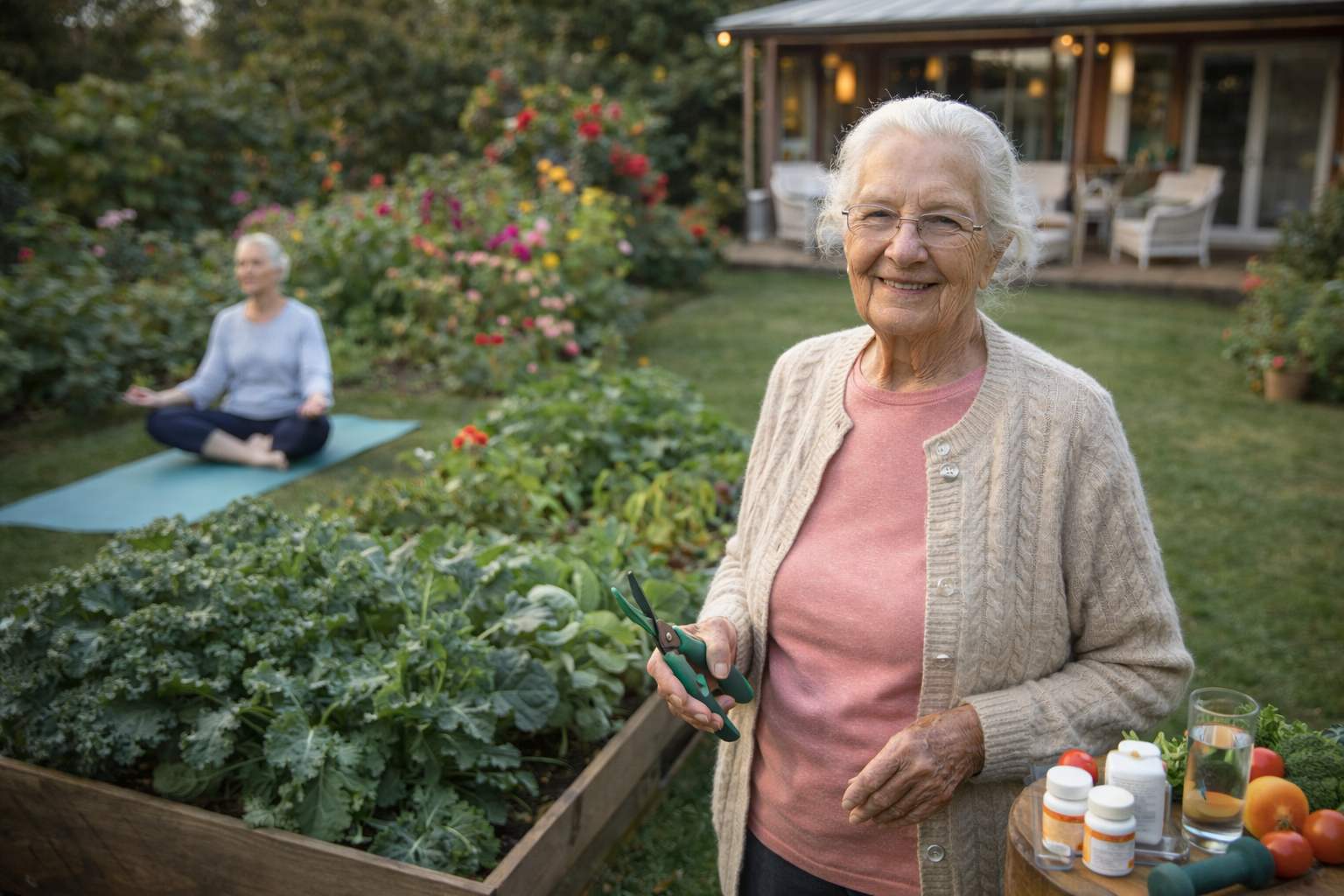
A 100-year-old woman reveals the daily habits that keep her thriving and why she’s determined never to end up in care

Margaret’s kettle whistles at 6:15 a.m. most mornings, the same time it has for decades. At 100 years old, she shuffles into her cottage kitchen in soft slippers, humming melodies from the 1940s, and the first thing she does is talk to her legs as if they’re old companions who need convincing. “Well, legs, you coming with me today or what?” She lives alone—no care workers on rotation, no medical alert hanging from her neck. Instead, there’s a notebook on her kitchen table with medicine times, friends’ birthdays, and three words written in thick blue pen: “STAY OUTSIDE CARE.”
This declaration isn’t dramatic or desperate. It’s methodical. Every habit in her day orbits around that single commitment, and what makes her story worth examining isn’t that she’s reached 100—plenty of people do. It’s that she’s reached 100 while remaining stubbornly in control of her own life, making her own decisions, and refusing the slow creep of dependency that claims so many others far younger. The question she raises, almost accidentally, cuts deeper than simple longevity: what does it actually mean to stay alive versus to stay yourself?
In care facilities across the developed world, thousands of people live longer than Margaret will ever live. Yet many report a specific kind of loss that has nothing to do with their bodies: the loss of permission to decide when they eat breakfast, what they wear, or whether they go outside. Margaret has watched this happen to friends, and it terrifies her more than death itself. That terror is what drives her daily routines.
The architecture of small, deliberate choices
Her day is not glamorous. Toast with marmalade for breakfast, loops around the garden wall, peeling carrots slowly for lunch. A visitor might see nothing remarkable at all. But every action follows the same quiet logic: keep moving, keep deciding, keep living according to your own design. When a community nurse once asked if she’d considered residential care “just in case,” the room went silent. Margaret turned from the window with sudden clarity. “That’s what I’m fighting every single day,” she said.
The architecture of this fight isn’t built on willpower or motivation. It’s built on three non-negotiables she follows almost religiously. First, daily movement—not gym workouts, but relentless small movements threaded through every hour. Walking around the garden. Climbing stairs twice instead of once. Standing during television adverts. Her phrase for it is blunt: “If you sit, you rust.” Second, decision-making autonomy. What to wear, what to eat, when to nap, even when her daughter offers to pre-cook all her meals. “No,” Margaret says, “I need to boss my own peas.” Third, social connection. Phone calls, church coffee mornings, gossip at the corner shop. These aren’t luxuries for her. They’re survival tools.
What’s remarkable is that she didn’t suddenly wake up at 90 and decide to live this way. According to research from gerontology institutions, the habits that protect independence in very old age are almost always built decades earlier, in the 60s and 70s. Margaret’s life is evidence of this truth. Twenty years ago, after watching a neighbor fall and never fully recover, she added a 10-minute balance routine before breakfast using the kitchen counter. Ten years ago, she swapped heavy gardening for lighter work so she could still care for her roses herself. These weren’t dramatic transformations. They were tiny adjustments, made long before they felt urgent.
The science behind the stubbornness
There’s actual research validating what Margaret’s instincts already knew. Geriatricians describe the “dependency cascade”—a small loss of mobility leads to less activity, which weakens muscles, which increases fall risk, which then becomes the justification for moving into care. The same pattern happens socially: miss a few gatherings, lose confidence, see fewer people, mind dulls, motivation fades. Before you know it, you’ve outsourced your entire life.
Margaret’s three pillars align precisely with what the National Institute on Aging identifies as factors that extend independent living: physical activity, cognitive engagement, and social connection. Her daily phone call to a friend isn’t just “being chatty”—it’s cognitive exercise and emotional buffering. Her insistence on deciding meal times helps preserve executive function. She might not use those clinical terms, but she feels the effect every time she closes the door behind a visitor and says softly, “Still mine. This is still mine.”
“I’m not trying to live forever. I’m trying to live as myself for as long as I can. Every time I let somebody do something I could still do, I lose a little bit of that self. So I fight for the little things. Washing my own cup. Choosing my own cardigan. Walking out my own front door.” – Margaret, quoted by her community nurse
The concrete rituals that quietly reshape a body
Margaret’s most tangible daily practice begins the moment she finishes her morning tea. She stands at the kitchen sink, places both hands lightly on the edge, and lifts one foot off the ground for ten slow breaths. Then the other foot. It’s basic balance training, the kind physical therapists teach but most people abandon after a few weeks. She calls it “leg rent.” “If my legs don’t pay their rent, they’ll be evicted.” Then come ten sit-to-stands from her favorite chair, no using her hands. The entire routine takes less than ten minutes but threads through her day, reminding her that strength is not a given—it’s something she renews daily.
When people hear her story, they often imagine a perfectly disciplined lifestyle. Margaret snorts at that. Some days she eats biscuits for dinner and watches game shows for three hours. “Let’s be honest: nobody really does this every single day.” The difference, she explains, is that she forgives herself quickly and returns to her basic routine the next morning. No drama. No self-recrimination. Just a reset.
The larger mistake she sees in people her age is surrendering tasks too early. A son who insists on doing all the shopping. A daughter who takes over the finances “to help.” These gestures come from love, but they chip away at competence and agency. Margaret accepts help for heavy lifting and medical administration, but she clings fiercely to things she can still manage, even if they take forever. It’s slower. It’s messier. But it keeps her brain and body switched on.
The rarely examined cost of well-meaning help
This is where Margaret’s story diverges from most conventional advice about aging. We’re trained to think that the goal is to make life easier for older people—to reduce their burden, to take over. But there’s a psychological cost to this kindness that rarely gets discussed. Each time a task is taken away, even with the best intentions, something shifts. The person being helped begins to experience themselves as diminished, less capable, less necessary. Over time, they internalize this shrinking sense of self.
Margaret has watched this happen in slow motion. Friends who gradually stopped cooking because their children insisted on bringing meals. Neighbors who stopped managing their own money because someone “helped.” The dependency wasn’t forced; it was offered gently, wrapped in love. Yet within a few years, these people had lost not just the ability to do these tasks, but the confidence that they could. They stopped believing in their own competence.
What Margaret guards fiercely is what psychologists call agency—the felt sense that you can act on the world and shape your own circumstances. This isn’t about pride. It’s about identity. She knows that the moment she surrenders the right to make decisions, even small ones, she begins to become someone else. Someone managed. Someone dependent. Someone no longer fully hers. Her refusal to accept this is quiet, but it’s absolute.
The uncomfortable realignment of what aging should mean
Spending time with Margaret gradually shifts how you think about aging itself. You begin noticing all the ways you outsource effort now: taking the lift for one floor, defaulting to takeaway meals, saying you’re too busy to call a friend. She’s not holding herself up as a saint—she’d roll her eyes at that idea. But her life throws a particular question back at the rest of us: are we preparing to stay alive, or are we preparing to stay in charge of our own lives?
She knows the line between living at home and living in care is thin. One fall, one stroke, one bout of serious illness could cross it. She doesn’t deny this possibility. That’s exactly why she treats every day as a small vote cast in favor of independence—not with fear or desperation, but with what might be called stubborn hope. She’s not fighting to live forever. She’s fighting to remain herself for as long as she possibly can. And that distinction matters.


