
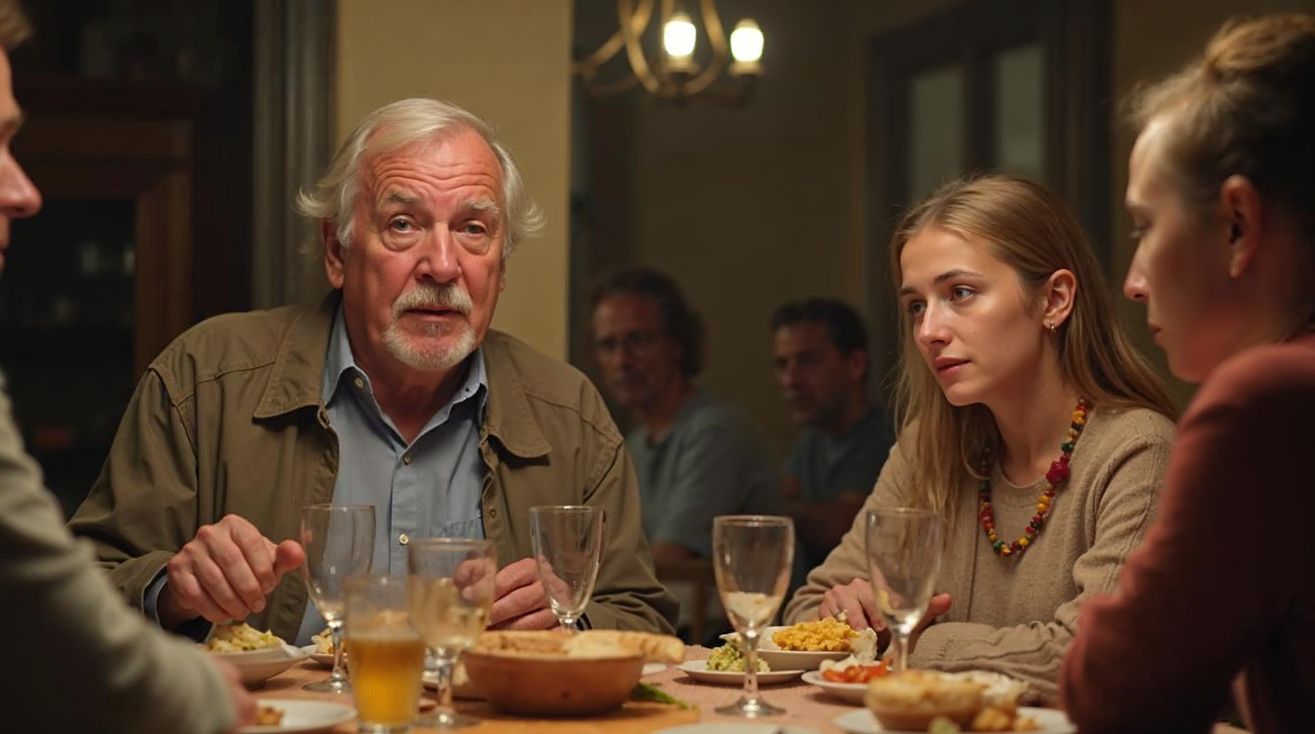
7 phrases used by people older than 65 that sound totally out of touch to young people

You’re sitting at a family lunch, half-scrolling on your phone under the table, when your grandfather suddenly says, “Back in my day, we didn’t have all this jazz.” Everybody laughs politely, but your cousin catches your eye and silently mouths a question mark. There’s a small jolt in moments like that. Not mean, not dramatic, just this noticeable gap between worlds. The words older people reach for were born in a different life: landlines, newspapers, five TV channels, and neighbors who actually rang the doorbell instead of texting “here.” Their phrases land in 2026 like they’ve time-traveled without updating the software, and you can feel the cringe ripple through the room.
This isn’t about rudeness or cognitive decline. It’s about language shaped by radically different circumstances. When someone over 65 opens their mouth, they’re often drawing from a playbook written in an era that no longer exists. The phrases feel clumsy to younger ears because they carry assumptions about how life works, what matters, and what people should tolerate. The disconnect is real, and it’s worth understanding not as a failure but as a window into how fundamentally our worlds have split.
The weight of “Back in my day”
Nothing ages a sentence faster than starting with “Back in my day.” For people over 65, it’s a warm doorway to memory, a way to say “I’ve seen things, let me share.” For younger people, the phrase auto-fills with judgment before the speaker even finishes. You hear it and your brain completes the rest: “we walked ten miles to school,” “we respected our elders,” “we didn’t waste food.” It’s not that the stories aren’t real. It’s that the phrase already announces a verdict on the present.
Picture this: you’re complaining that rent just went up again, and your grandfather leans back and says, “Back in my day, you could buy a house on one salary.” He’s not trying to hurt you. To him, he’s connecting. But the sentence lands like a brick because your “day” comes with student loans, unpaid internships, and an economy that doesn’t even remotely match 1975. You end up feeling judged for struggling in a game where the rules quietly changed. One sentence, and suddenly you’re not talking about rent anymore. You’re debating whether your generation is lazy.
This phrase hurts because it flattens reality. It puts “then” and “now” on the same line, as if prices, rights, and technology hadn’t transformed everything. The subtext young people hear is: “We had it harder and still managed, so what’s wrong with you?” Older people rarely mean it that way. They’re often trying to say, “I survived tough times, maybe you can too.” The fix isn’t to ban nostalgia. It’s to shift the opener. Swapping “Back in my day” for something like “When I was your age, it was different, I’m curious how it feels for you” keeps the story but removes the judgment.
The communication divide: calls versus texts
On paper, it sounds like such a simple suggestion: “Why don’t you just call?” To someone over 65, the phone call is still the gold standard of real communication. You hear the voice, you sense the emotion, there’s less room for misunderstanding. For younger people, the hierarchy is completely flipped. Texting is default, a voice call is escalation, a video call is borderline intimate. Picking up the phone without warning can feel like showing up at someone’s home unannounced and knocking non-stop.
Think of a teenager trying to explain a fight with a friend. They’re showing you walls of messages, screenshots, blue and gray bubbles that look like a forensic file. The grandparent looks confused and finally says, “Why don’t you just call and sort it out?” For them, the idea that conflict lives and dies in text threads feels absurd. For Gen Z, this is simply where relationships breathe. The call suggestion doesn’t land as “help.” It lands as “you’re doing communication wrong.” And if you’re socially anxious or neurodivergent, that ringing phone can feel like a fire alarm, not a friendly tool.
There’s a deeper cultural shift here. A phone call demands total presence: you drop everything, answer now, improvise. Texting respects fragmented attention and constant multitasking. Older generations grew up in a world where waiting by the phone was normal, where conversation was an event. Younger generations live in a stream of micro-messages, half-read between subway stops and work emails. The bridge phrase could be: “Is this something you’d rather talk about by message or by call?” Same desire for connection, less pressure.
The false comfort of comparative suffering
If there’s a phrase guaranteed to shut a young person down mid-sentence, it’s: “You kids have it so easy these days.” It usually appears right after someone under 30 mentions being tired, stressed, or overwhelmed. The older person hears “tired” and flashes back to double shifts, no social safety nets, raising kids with zero daycare. The intention is often to say, “We survived worse, so you’ll be okay.” What lands is, “Your pain doesn’t count.” The conversation stops being about your reality and becomes a competition no one will ever win.
Imagine a 25-year-old saying, “I’m exhausted, my job expects me to answer emails at 10 p.m.” Their retired uncle replies, laughing, “You kids have it so easy these days, at your age I worked six days a week in a factory, no holidays, no mental health days.” There’s truth in his memory. But the young person also faces constant digital surveillance, unpaid overtime masked as “flexibility,” and a cost-of-living crisis. No one got an “easy mode.” Just different bosses, different chains.
Younger people hear this sentence and feel erased. Not because they believe older generations had it easy, but because struggle is being treated like a trophy instead of a warning. Suffering shouldn’t be the benchmark for legitimacy. There’s a more generous way to acknowledge contrast: “Life was tough in my time too, but in a different way. What’s weighing on you the most right now?” That swap keeps the experience of the older person while opening space for the younger one.
Authority without reciprocity: “Respect your elders”
“Respect your elders” is one of those phrases that sounds noble on a greeting card. For people over 65, it carries the echoes of strict parents, teachers with authority, and a world where age automatically meant wisdom. The sentence was a shield: if you were older, you didn’t have to justify yourself. To many young people today, it feels distinctly one-sided. Respect is still valued, but they see it as something earned through behavior, not granted like a lifetime achievement award at 65.
Take a family argument about politics. A 20-year-old calmly questions a grandparent’s opinion, bringing in new information they’ve read. The grandparent, cornered and uncomfortable, ends the debate with, “You should respect your elders.” What they’re really saying is, “Stop challenging me.” The young person hears: “Your knowledge is worthless compared to my age.” And the silent message becomes: sit down, listen, don’t disagree. That’s not respect. That’s obedience.
“Sometimes the bravest thing an older person can say is: I’ve lived longer, but that doesn’t mean I’m always right. Help me understand how you see it.” – Social psychologist on generational communication
The tricky part is that both sides often want the same thing: to be heard. Older people fear being made irrelevant; younger people fear being dismissed. The phrase “respect your elders” tries to solve that by ranking people. It backfires. Respect flows better as a two-way system. Listening, asking questions, apologizing when we’re wrong, including each other in decisions.
Mental health vocabulary as progress, not weakness
This one usually arrives right after someone mentions therapy, anxiety, or setting boundaries. Older generations survived a culture where feelings were swallowed, not spoken. So when they hear about trigger warnings, burnout leave, or mental health days, some instinctively reach for: “Kids today are so sensitive.” To a 22-year-old battling panic attacks, that line doesn’t sound like commentary. It sounds like a slap. As if learning to name pain is weakness, not survival.
Picture a granddaughter confessing she cut off contact with a toxic friend. She explains the manipulation, the guilt, the exhaustion. Her grandmother frowns and says, “In my time we didn’t cut people off like that. Kids today are so sensitive, you just work things out.” She thinks she’s advocating resilience. What she’s really doing is dismissing boundaries as oversensitivity. The granddaughter walks away wondering if she’s broken for needing distance, instead of proud for protecting herself.
The gap here isn’t just language. It’s emotional education. According to research from the American Psychological Association, younger generations have significantly higher rates of diagnostic awareness for mental health conditions, not necessarily higher rates of the conditions themselves. Mental health vocabulary barely existed when many of today’s grandparents were young. Depression was “a bad mood.” Anxiety was “nerves.” Trauma was “life.” They adapted by toughening up because there were few alternatives. Their survival strategy becomes the standard by which they judge everything. Younger generations have words, diagnosis, therapy apps, online support. They’re not more fragile. They’re more named. A softer sentence could be: “We didn’t talk about feelings like this before, so it’s new to me. Tell me what helps you.” That moves from mockery to learning, and suddenly the sensitivity starts to look like strength.
The rarely discussed generational fear beneath the phrases
Underneath most of these clumsy sentences lives something that rarely gets discussed: the fear of irrelevance. Older people watch a world transform at a speed they can’t quite match. They see smartphones that mystify them, social rituals they don’t understand, career paths that didn’t exist when they retired. The defensive phrases aren’t really about younger people at all. They’re about older people protecting themselves against the terrifying possibility that their experience no longer applies.
When someone says “I’m not a computer person,” they’re often not announcing a limitation. They’re announcing a fear. Technology exposes vulnerability. Nobody likes feeling clumsy in front of their own grandchild. Rather than admitting fear or shame, it’s easier to reject the whole category: computers, smartphones, “all that stuff.” When someone criticizes younger people for being “too sensitive” or “always needing to post,” they’re sometimes working through their own discomfort with a world that seems to value things differently now.
This doesn’t excuse the phrases. It just explains them. And explanation is the first step toward translation. If a younger person understands that “You kids have it so easy” might really mean “I’m afraid I’m becoming useless,” the sting changes shape. It becomes something to address together instead of something to defend against separately.
“Why do you always need to post everything?”
Scrolling at the table, taking a photo of your food, filming a 5-second clip for your story. For many older people, it all blurs into one accusation: “You’re addicted, you’re vain, you’re not present.” The phrase that pops out is: “Why do you always need to post everything?” From their perspective, life is being traded for likes and validation. From yours, sharing is part of how experience becomes memory, community, even work.
Think about a 19-year-old on a trip of a lifetime. She snaps a photo of a sunset, adds a song, posts it. Her grandfather shakes his head: “Can’t you just enjoy the moment? Why do you need to post everything?” To him, the post interrupts reality. To her, it extends it. That story means friends react, conversations start, the memory doesn’t just sit in her head. Posting is not proof that she wasn’t present; it’s evidence that she was. When older people attack the habit, younger people feel like their entire social life is being misread. It’s not “showing off.” It’s how they stay in the room with people who aren’t there.
There’s a real concern underneath the critique: attention is finite. Adults over 65 see faces lit by screens instead of eye contact at dinner and feel pushed aside by invisible audiences. They miss undivided presence because they grew up when being unreachable was normal, even peaceful. A more bridging way to voice that is: “I’d like some moments with you where the phones are away, can we agree on that?” That shifts from judgment of the habit to a request for connection. Young people usually aren’t against boundaries. They just don’t want their digital life labeled as emptiness.
The translation problem we’re all living through
The phrases older than 65-year-olds use don’t sound out of touch because the people are out of touch. They sound that way because those words were built for a world that doesn’t quite exist anymore. Underneath each clumsy sentence there’s often a decent impulse: protect, guide, connect, warn. Young people, for their part, are tired of being treated like a glitch in history instead of the next chapter. They’re juggling problems their grandparents never saw coming, with tools their grandparents never had.
What if we treated these awkward phrases as translation errors rather than failures of character? The next time you hear “Back in my day” or “Kids today are so sensitive,” you could gently probe what fear or hope is hiding underneath. And if you’re the one over 65, you might experiment with one small swap: turning statements into questions. Different decades, same human need. To be seen, without being reduced to a stereotype from someone else’s past. The work isn’t to eliminate these phrases or to mock the people who use them. It’s to develop the patience and curiosity to ask: what are they really trying to say?


