
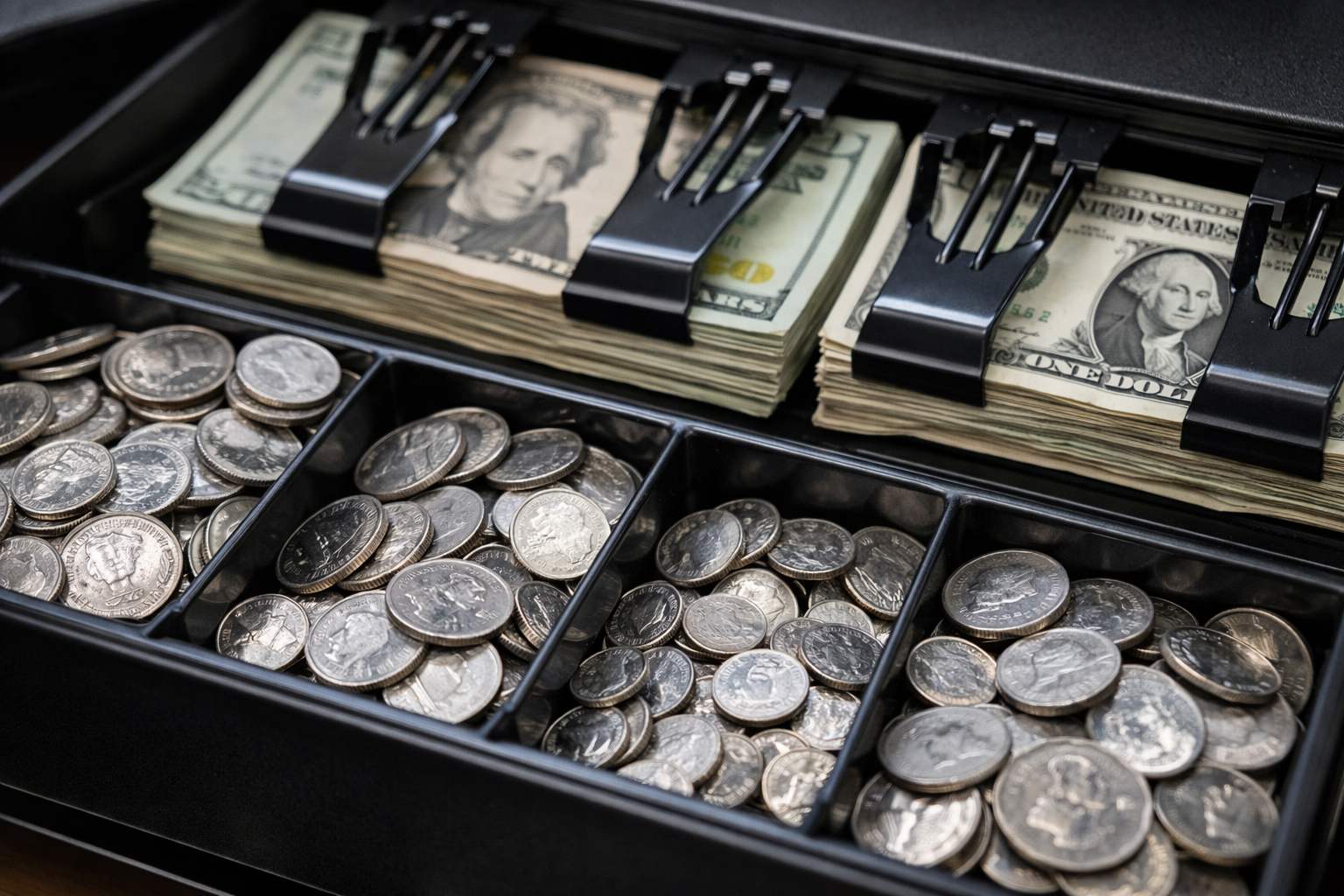

The moment that separated Steve Whitmore’s ordinary workday from an extraordinary turning point arrived quietly, without fanfare. He was doing what he’d done thousands of times before—running his fingers through the cash register at his gas station in South Conway—when something stopped him. A half-dollar coin with an unusual gleam caught his attention. Most people would have moved on. Whitmore didn’t.
What followed wasn’t the kind of story that makes headlines because someone got lucky. It’s the kind that raises harder questions about what we overlook in plain sight, what expertise means in an age of specialization, and how the value of objects exists in layers we rarely acknowledge. A casual discovery at a gas station cashier became a $3.21 million transaction, but the real story runs much deeper than the price tag.
The coin itself—a 1964 Kennedy half dollar prototype—represents something more than numismatic rarity. It’s a physical artifact from a specific moment in American history, minted in 90 percent silver shortly after President Kennedy’s assassination. Its lack of a mint mark made it a ghost in the system for collectors, something many believed had been lost or destroyed decades ago. Finding it in daily circulation was, by any serious measure, close to impossible.
How expertise revealed what visibility concealed
Whitmore’s instinct to seek professional evaluation proved decisive. He contacted specialists at the American Numismatic Association, and what followed was a systematic authentication process that transformed a curious object into a documented treasure. The Professional Coin Grading Service assigned it a PR69 rating—one point below perfection—which accelerated everything that came next.
“Coins like this are legendary. For years, many believed this coin was lost or melted down. To find one casually in a gas station cash register is astounding.” – Amanda Rollins, Senior Expert, American Numismatic Association
This moment illustrates something important about value in contemporary life. An object can sit in circulation, pass through thousands of hands, and remain worthless until the right person with the right knowledge examines it properly. The coin wasn’t more valuable on the day Whitmore found it than it was before—but its discovered value depended entirely on expert authentication and market knowledge. Without those credentials, it would have remained indistinguishable from any other half-dollar.
The mechanics of rarity in a connected world
Once word spread about the discovery, the market moved with remarkable speed. According to numismatic auction records and collector networks, rare coin valuations have accelerated substantially over the past decade as wealthy collectors increasingly diversify portfolios into alternative assets. The $3.21 million sale price reflected both the coin’s technical specifications and broader trends in high-end collectibles.
What makes this particular discovery noteworthy for understanding modern markets is how quickly information traveled and how efficiently bidders organized themselves. In previous generations, a find like this might have taken months or years to surface through local dealers and national publications. Today, a single authentication can trigger global interest within days.
The private sale price set a record for its type, meaning collectors recognized this as a definitive example—perhaps the only existing specimen in this condition with these characteristics. That kind of uniqueness commands premiums that defy traditional valuation methods. There’s no comparable recent sale to anchor the price. Collectors essentially bid for the chance to own something that cannot be replicated.
What the discovery reveals about attention and ordinary moments
There’s a psychological dimension to Whitmore’s experience that extends beyond the financial outcome. He was working in an environment where repetition usually dulls perception. After handling thousands of coins, most people develop a kind of cognitive autopilot. The coins become background noise—fungible, interchangeable objects that flow through the register as part of daily commerce.
Whitmore broke that pattern by actually looking. Not in a mystical sense, but in the specific, deliberate sense of pausing routine to examine what he was handling. He noticed an unusual shine, pristine condition, and something aesthetically distinct from the ordinary currency moving through his drawer. That sensory awareness—sometimes called attentional presence in psychology literature—is uncommon in repetitive work environments.
His reflection on the discovery captures this precisely: “I’ve handled thousands of coins in my job, but this one changed everything.” The implication isn’t that he suddenly became rich. It’s that he discovered his own capacity for observation had value attached to it. Under different circumstances, with different attention patterns, he would have never known what passed through his hands.
The overlooked human dimension of accidental discovery
Most narratives around this event focus on the monetary outcome or the rarity specifications. What deserves more consideration is the existential weight of such discoveries for the people who make them. Whitmore’s statement—”To think a single coin could be worth more than my entire business was beyond anything I imagined”—indicates the profound disorientation that comes with unexpected windfall.
This isn’t simply about gaining wealth. It’s about the collision between your understood position in the economic world and a sudden revelation that you were unknowingly proximate to resources at an entirely different scale. The coin didn’t make Whitmore rich. The discovery revealed that he had been, in effect, handling wealth without recognizing it.
According to the American Numismatic Association’s research on collector behavior, approximately 3.2 million people in North America actively participate in coin collecting, yet the community remains fragmented and largely invisible to the general public. Most valuable discoveries come not from systematic searching but from incidental encounters—estate sales, inherited collections, or exactly the kind of moment Whitmore experienced.
The real question his story raises isn’t whether you might find money in your register. It’s whether the world contains layers of value that we systematically ignore because we’ve learned to look through most of what surrounds us. What else are we handling daily without recognition?


