
A major polar vortex disruption is reportedly developing with a February magnitude almost unheard of in modern records

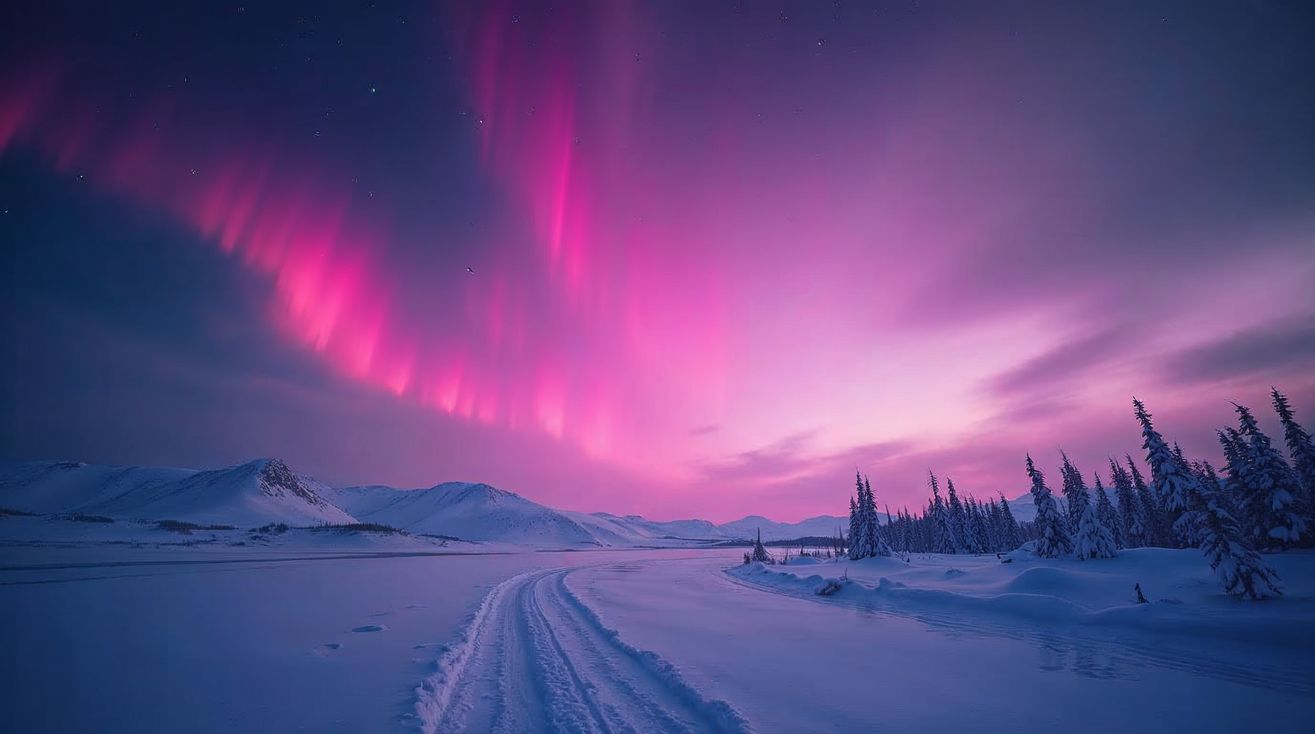
A photograph circulated on social feeds showing electric pink and purple auroras rippling across the Arctic sky, accompanied by a forecaster’s warning that seemed unusually blunt: a major polar vortex disruption was developing, and its February magnitude was almost unheard of in modern records. Outside, the world looked unchanged—ordinary streets, ordinary gray skies. Yet tens of kilometers above the Arctic, in the thin upper atmosphere, something remarkable was happening. The vast ring of westerly winds that normally spins around the pole like a contained flywheel was beginning to wobble violently.
What made meteorologists sit up straighter in their chairs was not just that a disruption was occurring, but when and how intensely it was occurring. Sudden stratospheric warming events do happen in winter, but for February to see one of this strength was, in professional language that rarely overstates things, genuinely striking. The implications rippled outward in subtle ways: jet streams could buckle, storm tracks could shift, and regions expecting the slow fade of winter could find themselves back in its grip. For people living through what felt like ordinary late winter, the invisible drama unfolding overhead carried genuine consequence.
The challenge for anyone trying to understand what this means lies in the disconnect between scale and visibility. The polar vortex exists at the edge of our atmospheric envelope, a phenomenon almost nobody thinks about until it starts affecting their weather. When it does, the results can be dramatic, but the causal chain is long and complex enough that most forecasters struggle to explain it without sounding either alarmist or evasive.
The mechanics of a weakening vortex
Think of the polar vortex as a spinning top. In a stable winter, it remains centered and strong, a reliable container for the coldest air. Westerly winds circulate at speeds that can exceed 100 knots, and that circulation matters because it acts like a barrier. Cold air gets trapped near the pole, and midlatitude regions experience weather that’s seasonal but not extreme.
When the vortex weakens, that top begins to wobble. The ring of fast winds decelerates, sometimes reversing direction entirely in the stratosphere. Stratospheric temperatures can surge by tens of degrees in just a few days—a dramatic shift for an altitude where the air is already brutally thin and cold. According to meteorological agencies tracking this event, the current February setup shows stratospheric wind speeds weakening at rates that rank among the strongest recorded in modern data.
The mechanism driving this disruption appears rooted in wave activity from the troposphere below. Planetary-scale waves generated by mountain ranges, ocean temperature patterns, and atmospheric pressure systems can propagate upward and literally batter the vortex until it breaks apart or tilts. When that happens, the vortex doesn’t vanish—it splits, distorts, or relocates. Cold air that was bottled up suddenly has pathways to slip southward in irregular lobes.
Why history offers an uncomfortable lesson
The 2021 experience remains the frame of reference most people use. In February of that year, a major polar vortex disruption allowed Arctic air to plunge into the southern United States with devastating speed. Texas, a state rarely prepared for deep cold, descended into crisis. Power grids failed. Millions lost electricity and heat in a situation that turned fatal within days. The event was unusual enough that it prompted genuine scientific inquiry into whether such disruptions were becoming more common.
This year’s setup is not a copy of 2021, and every weather pattern carries its own fingerprint. Model projections suggest the stratospheric signal could influence surface weather for one to three weeks, potentially extending from late February into March. Where that influence manifests geographically—whether as bitter cold, heavy snow, powerful wind events, or some regions experiencing mild conditions while others freeze—remains uncertain. That uncertainty is itself important to understand.
Meteorologists are caught between competing professional obligations: warning people about a genuinely unusual pattern while resisting the temptation to overstate what remains an evolving situation.
“From a stratospheric perspective, this is one of the more striking February disruptions we’ve seen in modern records. That doesn’t guarantee historic weather on the ground, but it does strongly tilt the deck toward volatility in late February and early March.” – European Climate Scientist
The phrase “tilt the deck” matters. It acknowledges real risk without manufacturing certainty that doesn’t exist.
The practical calculus for the next two weeks
For most people, the relevant question is not whether the polar vortex is disrupting but what to do with that knowledge. The answer is simpler than the science. Shorten planning horizons. If you habitually lock in travel, outdoor plans, or work schedules based on 10-day forecasts, reduce that to three to five days. The influence of a stratospheric event takes time to materialize in surface weather, and details often shift between forecast cycles.
Watch trend lines rather than individual maps. Is your local forecast gradually shifting colder, stormier, windier with each new update? That creeping movement often signals more than a single dramatic headline map shared on social media. Pair your standard weather app with a trusted national meteorological service or a reputable local forecaster. They often discuss uncertainty and pattern shifts more honestly than generic applications.
Keep basics ready: layers, blankets, fuel tanks above half, phone charging backups. For travelers, build flexibility into plans where possible. For parents, monitor school alerts more closely. None of this requires panic. It requires the kind of attentiveness most of us only muster after something’s already going wrong.
The unresolved question about future winters
The deeper discomfort underlying all this concerns whether these polar vortex disruptions represent freak accidents or a new pattern emerging in a warming world. The scientific consensus remains genuinely divided. Some recent studies suggest that Arctic warming, shrinking sea ice, and declining snow cover may be destabilizing the atmosphere’s typical balance, potentially making sudden stratospheric warmings more frequent or intense in certain years. Other researchers argue the signal is still too entangled with natural variability to draw firm conclusions.
What’s less debatable is the lived experience: winters that shift from relatively mild to brutally cold in days, then back again. The seasons feel less like steady chapters and more like jump cuts, with little time to adapt psychologically or logistically. Whether this reflects a long-term climate shift or a temporary clustering of unusual events remains an open question that science has not yet settled.
The rarely explored dimensions of atmospheric volatility
What often escapes mainstream weather discussion is the cumulative psychological impact of constant recalibration. People adapt to stable patterns, adjusting their wardrobes, schedules, and expectations accordingly. When winter becomes a series of sharp reversals rather than a predictable progression, that adaptation becomes exhausting. The risk tolerance for planning shifts downward. Trust in forecasts erodes slightly with each revision.
There’s also an economic dimension that remains mostly invisible. Industries dependent on seasonal stability—construction, outdoor retail, agriculture—bear the cost of disrupted planning far more acutely than those who simply adjust their weekend plans. Small businesses operating on tight margins can’t absorb repeated forecast changes the way larger operations can.
The stratosphere’s behavior, framed in scientific abstractions, ultimately filters down through the texture of ordinary life: the decision about whether to buy that heating oil, whether to schedule outdoor work, whether to book that flight with confidence. These decisions accumulate into a kind of ambient uncertainty that shapes how people move through their seasons.
The polar vortex will either stabilize or further destabilize in the coming weeks. Models will update repeatedly. Some forecasts will verify; others will miss. What remains constant is that the sky, invisible as it is to most of us most of the time, continues its work of shaping the world we move through. Paying attention to it, even imperfectly, remains a small act of preparation in a climate that increasingly demands flexibility.


