
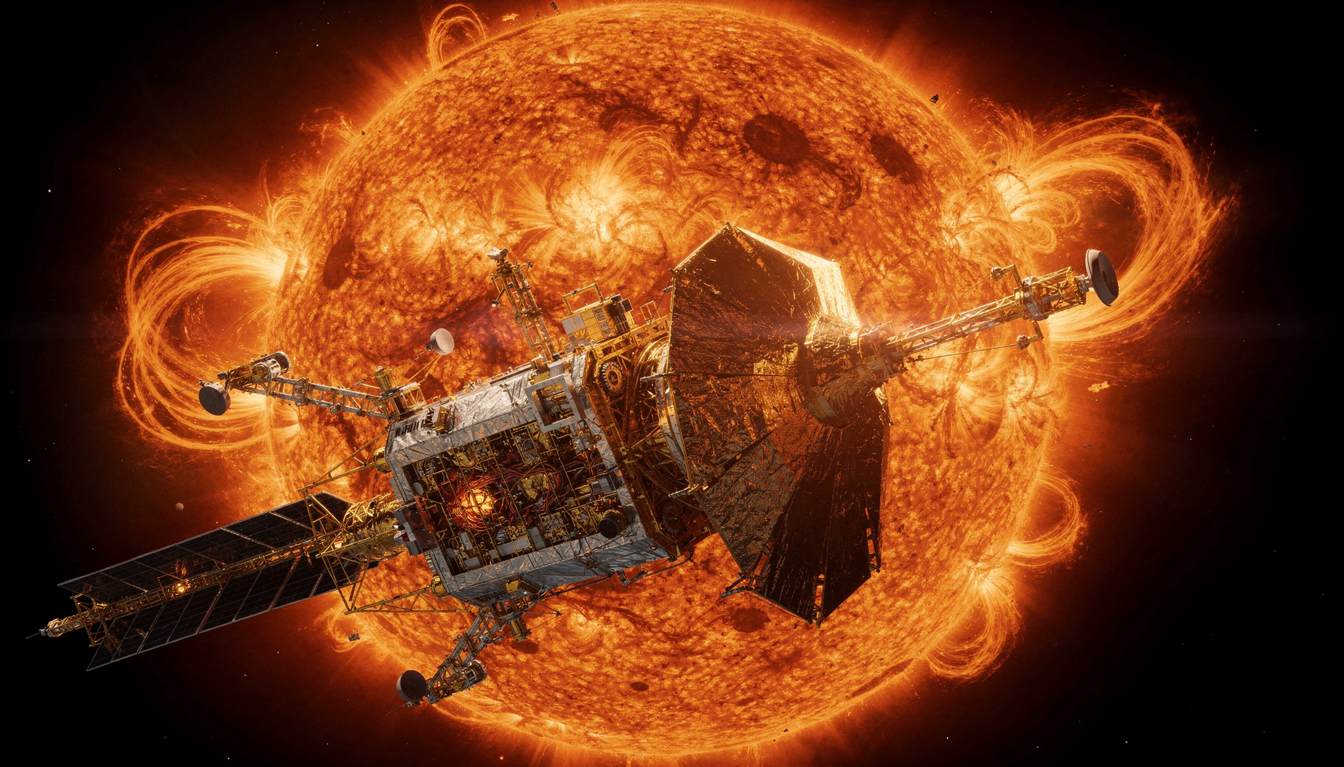

A small spacecraft roughly the size of a car has accomplished something extraordinary: it has ventured closer to the Sun than any human-made object in history. NASA’s Parker Solar Probe is fundamentally changing our understanding of the star at the center of our solar system, and the discoveries it’s making could have significant implications for life on Earth and our future in space.
The Parker Solar Probe represents one of the most ambitious and daring missions ever undertaken by space agencies. Launched to study the Sun’s outer atmosphere, the probe has flown within 6 million kilometers of the Sun’s surface—a distance that seems vast until you consider the scale of space itself. At that proximity, the spacecraft enters the corona, the Sun’s mysterious outer layer, giving scientists an unprecedented view of solar processes that were previously only theoretical. This achievement resonates particularly with Portugal’s growing space industry ambitions, as the country develops its own satellite capabilities and space technology sector.
• Closest approach: 6.1 million kilometers from Sun’s surface (December 2024)
• Speed at closest approach: 700,000 kilometers per hour
• Temperature withstood: 1,377°C (2,500°F) on heat shield
• Mission duration: 7 years with 24 planned solar encounters
So why send a spacecraft on such a perilous journey into the solar furnace? The answer lies in understanding one of the most powerful and unpredictable forces in our solar system: solar storms. These massive eruptions of energy, known as coronal mass ejections, regularly blast waves of charged particles into space. While the Sun’s heat and light sustain all life on Earth, these violent solar events pose genuine threats to modern technology and human space exploration.
Solar storms can disrupt satellite communications, interfere with GPS systems, knock out phone signals, and even damage power grids across entire regions. As humanity becomes increasingly dependent on satellite technology and space-based infrastructure, understanding and predicting these events becomes critical. This vulnerability is particularly relevant for Portugal’s expanding telecommunications infrastructure, including the ongoing 5G network deployment across major Portuguese cities, which relies heavily on satellite-based systems that could be disrupted by severe solar weather events.
Astronauts venturing beyond Earth’s protective magnetic field face increased radiation risks during solar storms. For these reasons, NASA invested in the Parker Solar Probe to observe solar activity directly and unlock the secrets of space weather prediction.
Equipped with a sophisticated shoebox-sized camera, Parker has captured the most detailed images of the solar corona and solar wind ever recorded. The solar wind itself is a constant stream of charged particles flowing outward from the Sun at speeds of hundreds of kilometers per second. These observations have provided scientists with data that simply wasn’t available before.
Among the most striking discoveries is something that surprised even experienced solar researchers. According to NASA’s Johns Hopkins Applied Physics Laboratory, Parker recorded several solar explosions occurring in rapid succession—comparable to waves crashing sequentially on a beach. This phenomenon, rarely observed before, offers crucial insights into why certain solar storms prove more dangerous than others. The probe captured evidence that explosions can pile up and reinforce one another, creating more powerful disturbances in the solar wind.
“Parker Solar Probe has made history by flying closer to the Sun than any human-made object before, breaking its previous record by reaching just 3.8 million miles above the solar surface” – Johns Hopkins Applied Physics Laboratory, December 2024
This finding carries practical importance. By understanding how these consecutive explosions develop and amplify, scientists can refine their models for predicting solar storm intensity and impact. Better predictions mean better preparation. When we can forecast severe space weather events with greater accuracy, power companies can take precautions to protect electrical grids, satellite operators can move assets to safer orbital positions, and space agencies can reschedule astronaut activities or adjust mission timing.
Minor (G1): Weak power grid fluctuations, minor satellite operations impact
Moderate (G2): High-latitude power systems affected, GPS accuracy reduced
Strong (G3): Voltage corrections required, satellite navigation degraded
Severe (G4-G5): Widespread power outages possible, complete satellite blackouts
The Parker Solar Probe has also gathered data that challenges some long-held assumptions about the Sun. The corona remains one of solar physics’ greatest puzzles. The Sun’s surface, or photosphere, reaches temperatures around 5,500 degrees Celsius, yet somehow the corona above it reaches millions of degrees. This counterintuitive phenomenon—where the outer atmosphere is far hotter than the surface—still lacks a complete explanation. Parker’s observations are providing clues that could eventually solve this mystery.
Another major question involves the mechanisms that power solar storms. While scientists understand the basic magnetic processes involved, the precise triggers and acceleration mechanisms remain incompletely understood. Parker’s proximity to these events allows instruments to measure magnetic fields and particle energies with unprecedented precision, filling gaps in current models. This research has implications for Portugal’s technology sector, particularly for companies focused on protecting critical infrastructure from space weather threats.
The success of Parker has energized the scientific community. Future missions are already being planned, and space agencies worldwide are developing their own solar observation programs. The European Space Agency’s Solar Orbiter and other missions will work alongside Parker to create a more complete picture of solar activity. This collaborative approach reflects the global importance of understanding our star.
Looking ahead, the implications of this research extend far beyond academic astronomy. As space tourism develops and private companies plan missions to establish lunar bases and eventually Mars, understanding solar hazards becomes increasingly practical. Protecting astronauts from radiation, ensuring mission success, and developing safe spacecraft designs all depend on better solar knowledge.
Back on Earth, this research matters too. As our civilization becomes more technologically interconnected, our vulnerability to space weather increases. A major solar storm hitting modern infrastructure could cause economic disruption on a scale rarely considered by most people. Power systems, financial networks, communication systems, and countless other critical infrastructure components depend on satellites and electronics susceptible to solar radiation. The Parker Solar Probe’s discoveries help us prepare defenses against these possibilities.
The Sun, that seemingly simple bright orb in the sky, turns out to be far more complex and dynamic than ancient peoples could have imagined. Within its corona, physics operates under extreme conditions that can barely be replicated in laboratories. Studying the Sun teaches us about plasma physics, magnetic fields, and particle acceleration in ways that have applications throughout science and technology, including advances in machine learning systems that could help predict and analyze space weather patterns.
• Solar wind speeds vary from 300-800 km/second depending on solar activity
• Coronal mass ejections can reach Earth in 15-18 hours during high-speed events
• The solar magnetic field is 10,000 times stronger than Earth’s magnetic field
• Parker has survived temperatures equivalent to 2,500°F while maintaining operations
Every time the Parker Solar Probe completes another orbit and dips closer to the solar furnace, it sends back data that incrementally advances human knowledge. Scientists pour over these measurements, looking for patterns and anomalies that might unlock secrets hidden within the Sun’s outer atmosphere.
The next time you feel the Sun’s warmth or see it setting on the horizon, remember that a small spacecraft is out there, circling closer than anything humanity has built before, gathering intelligence on one of nature’s most powerful and beautiful phenomena. Through Parker’s eyes, we’re not just observing the Sun—we’re learning to predict its moods, understand its mysteries, and ultimately, protect ourselves from its fierce beauty.