
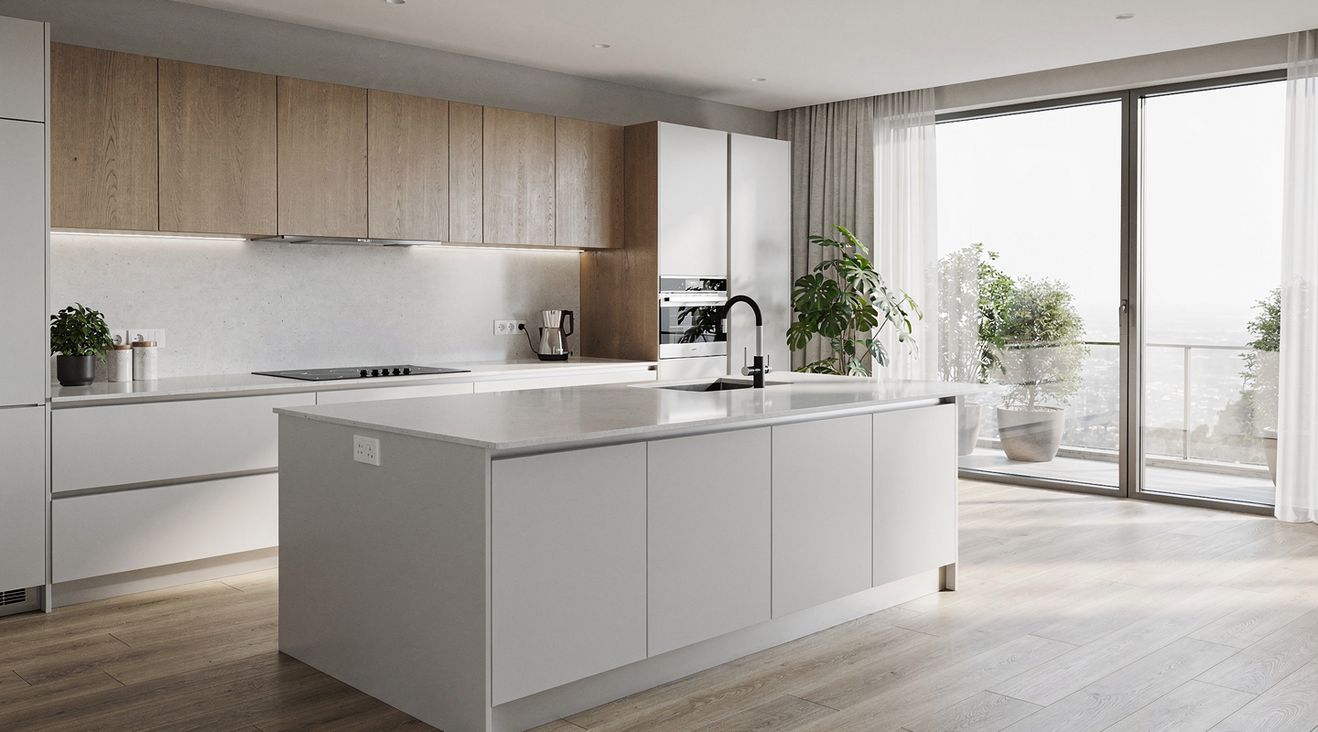

Saturday morning, 10:17 a.m., and the kitchen looks like a battlefield. Half-cut lemons scattered across the island, cereal bowls pushed to one side, a laptop claiming its territory, someone wrestling with pastry dough in whatever space remains. You’re trying to prep lunch, your partner wants coffee, a child needs a corner for homework. Everyone converges around that massive block in the middle like cars at a roundabout with no traffic rules. At some point, you stop admiring it and start resenting it.
This collision of functions is becoming impossible to ignore. The kitchen island—that centerpiece of modern home design that promised elegance, extra storage, and family connection—has quietly revealed itself as a source of daily friction in millions of homes. And designers have finally noticed. The shift is already happening in the kitchens that matter most: high-end renovations, contemporary apartments, and homes designed for how people actually live rather than how magazines suggest they should.
The era of the commanding kitchen island isn’t quite over, but it’s being replaced by something more honest about the way we move through our spaces.
The peninsula replaces the block
Walk into contemporary kitchens designed in 2025 and 2026, and you’ll notice something immediately: more breathing room. The space feels open, light, almost like a studio rather than a workstation. That massive island you expect to see? Often gone, replaced by something slender and purposeful—a peninsula attached to a wall, or a set of modular kitchen tables that can slide, pivot, and disappear when not needed.
Interior architects are calling this the post-island kitchen. Instead of a fixed block occupying the center, designers favor L-shaped peninsulas attached to a wall or slim, mobile prep tables that can be parked against a side when not actively used. According to a Parisian real-estate agency cited in design industry reports, listings featuring flexible table-peninsula kitchens generated 27% more engagement in 2024. People aren’t just looking for pretty anymore. They’re looking for movement.
The reason isn’t complicated: our kitchens serve radically different functions throughout the day. A breakfast zone at 7 a.m., an office from 9 to 11, a snack bar at 4, a laboratory during weekend batch cooking, a bar when friends arrive. A static island, no matter how pristine, struggles with this constant flux. A peninsula or modular table adapts. One side holds storage and prep, the other offers seating. You can extend it with a pull-out, rotate a mobile element, or fold everything back to clear the floor. The kitchen isn’t performing for guests anymore. It’s serving your actual life.
Converting your existing space without demolition
If you already have an island, you don’t need to tear everything down. The most practical conversion involves transforming it into a peninsula or hybrid kitchen table that anchors to a wall or side cabinet. The principle is straightforward: free the center. You keep the counter surface you value but attach one end to a structure, creating a clear pathway through the room. This single change transforms traffic patterns, especially in smaller and mid-size homes.
You can also replace bulky closed bases with lighter legs and shallow drawers, creating an illusion of more floor and more light. The mistake many households made was copying magazine spreads designed for 60-square-meter American kitchens into 25-square-meter European living areas. The result was usually an expensive, beautiful obstacle.
“Once we removed the island and installed a narrow peninsula with a rounded corner, the entire kitchen felt one size bigger,” says London-based kitchen designer Elena Rossi. “My clients stopped walking around a block and started walking through a room. That’s the difference.”
A peninsula typically demands less clearance behind it than a central island. You can run it parallel to a wall of appliances or perpendicular like a T, maintaining comfortable passage to the living room. Honest assessment: nobody uses four bar stools around all sides of an island daily. Two well-placed seats on the living-room side of a peninsula prove far more functional.
The hidden shift in how we think about kitchen space
Something deeper is happening in our approach to kitchen design. For years, the island functioned as a status symbol—a visible marker of achievement, the centerpiece of an open-plan performance space. Now that we work from home, eat there more frequently, and live in closer quarters, that showpiece mentality is dissolving. According to design trends tracked by industry publications, the shift toward practical flexibility over monumental display has accelerated significantly since 2023.
The kitchens feeling right in 2026 are less about grandeur and more about kindness to daily life. A peninsula that allows one person to cook while another passes behind with laundry. A narrow prep table that wheels out of the way for yoga mats or children’s play. A breakfast edge that doubles as a Zoom desk without broadcasting from the sink. The kitchen is no longer about impressing anyone. It’s about functioning honestly within the spatial and temporal constraints of real households.
This represents a genuine departure from the design philosophy that dominated the 2000s and 2010s. We’re moving away from architectural statements toward what might be called architectural kindness—solutions that acknowledge our messier, multi-functional reality rather than imposing order from above.
The neglected comfort of open movement
One aspect rarely discussed in design coverage is the psychological relief that comes from open kitchen space. There’s a measurable difference between moving through a room and moving around an obstacle. When the center is clear, circulation becomes effortless rather than a series of navigational problems. You’re not sidestepping anyone or calculating angles. You’re simply moving.
This matters more than it might initially seem, especially in homes where multiple people prepare food or work simultaneously. The number of unspoken household conflicts that stem from kitchen congestion is rarely quantified, yet anyone living in a cramped space recognizes it immediately. A clear central passage isn’t just aesthetically lighter—it’s emotionally lighter. The kitchen stops feeling like a place where people collide and starts feeling like a place where life happens.
There’s also a practical cleaning advantage that design magazines rarely emphasize. Open legs instead of solid bases mean you can actually sweep under furniture. Fewer seating positions means fewer crumb collection zones. The modular approach allows you to move elements for deeper cleaning. These small functional advantages accumulate into genuine quality-of-life improvements.
What we’re witnessing isn’t simply a style change. It’s a recalibration of what we actually value in our kitchens—a recognition that the most beautiful kitchen is the one that disappears into daily life rather than commanding it. The question now isn’t whether your kitchen island impresses visitors. It’s whether your kitchen serves the people who live there.


