
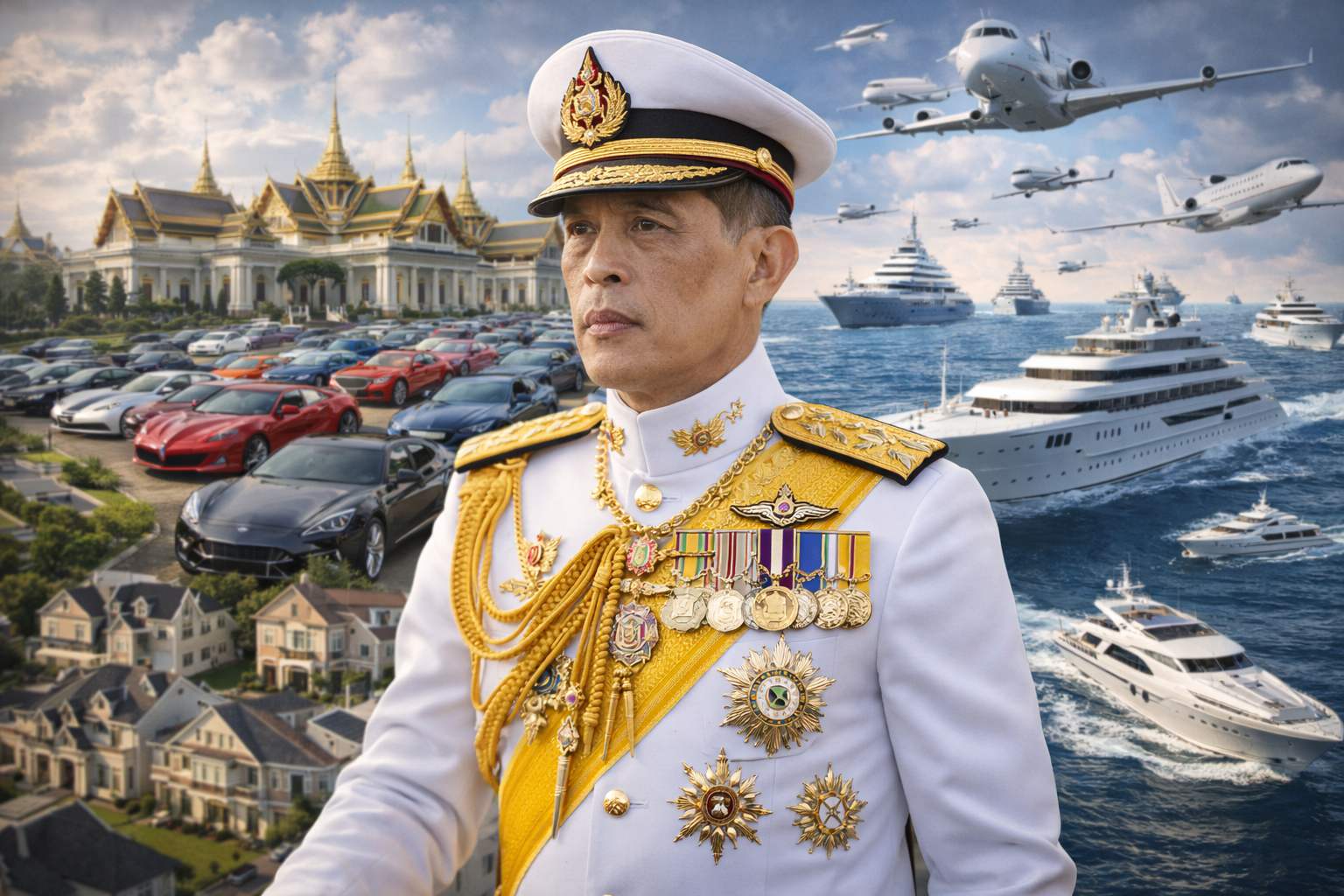
He’s the world’s richest king: 17,000 homes, 38 private jets, 300 cars, and 52 luxury yachts

The world’s most opulent monarchy operates in a sphere so removed from ordinary reality that the numbers themselves seem to break down. 17,000 homes, 38 private jets, 300 luxury vehicles, and 52 yachts belonging to a single royal family. These aren’t just statistics on a balance sheet. They represent a concentration of wealth so extreme that it fundamentally reshapes how power operates in the modern world.
This isn’t the fairy-tale monarchy of storybooks. This is wealth as a political system, where the boundary between state resources and personal luxury has been methodically erased over decades. The scale forces us to confront uncomfortable questions about how such accumulation becomes possible while millions struggle with basic necessities. The gilded excess tells a story about our global economic architecture that extends far beyond any single throne.
A fortune that defies comprehension
To understand this level of wealth, you need to abandon normal reference points. The Saudi royal family, led by King Salman and Crown Prince Mohammed bin Salman, has built an empire that spans continents and industries. Their fortune isn’t simply inherited treasure or successful business ventures. It’s the systematic conversion of a nation’s natural resources into private assets through decades of absolute rule.
The oil beneath Saudi Arabia generates hundreds of billions annually, flowing through networks of royal foundations, investment funds, and shell companies that all trace back to the same family. According to the Brookings Institution, this system allows the monarchy to treat national wealth as personal property in ways that would be impossible in democratic societies.
Consider the logistics alone. Managing 17,000 properties requires armies of staff, security teams, maintenance crews, and administrators. Each residence must be climate-controlled, secured, and ready for potential royal visits that may never come. The annual carrying costs dwarf the entire budgets of small nations, yet represent mere overhead for this level of concentrated power.
The machinery of absolute luxury
The 38 private aircraft include flying palaces with gold-plated fixtures, prayer rooms, and sleeping quarters more luxurious than most five-star hotels. These aren’t occasional indulgences but essential infrastructure for a family that treats the globe as their private domain. Flight crews remain on constant standby, fuel costs run into millions monthly, and maintenance requires specialized facilities on multiple continents.
The yacht collection spans from 100-foot “day boats” to 500-foot floating estates complete with helipads, movie theaters, and medical facilities. Some remain moored in exclusive marinas for months without use, their crews maintaining pristine condition for owners who may arrive without warning. The 52 vessels represent mobile kingdoms, each equipped to sustain royal comfort indefinitely while avoiding the scrutiny that comes with fixed locations.
The automotive fleet ranges from armored limousines to rare supercars, many custom-built with bulletproof glass, encrypted communications, and interior appointments that cost more than average homes. Multiple vehicles are positioned strategically around the world, ensuring the royal family never lacks transportation options that meet their security and comfort requirements.
The human cost of concentrated power
This extraordinary wealth accumulation occurs within a system where political dissent is criminalized and media criticism of the monarchy can result in imprisonment or worse. The Saudi population lives under conditions where questioning royal excess isn’t just discouraged but genuinely dangerous. This creates a feedback loop where extreme accumulation faces no meaningful checks or balances.
According to Human Rights Watch, the kingdom’s wealth concentration coincides with systematic suppression of labor rights, women’s freedoms, and religious minorities. The gleaming palaces and luxury fleets exist alongside migrant worker camps, restricted educational opportunities, and limited economic mobility for ordinary citizens.
The gap between royal lifestyle and citizen experience isn’t just about money. It represents a fundamental divide in human worth and opportunity. While the royal family accumulates properties they’ll never visit, Saudi Arabia’s healthcare system, educational infrastructure, and social services operate under budget constraints that seem absurd given the nation’s resource wealth.
“When state resources become indistinguishable from royal assets, every public policy decision becomes a question of family interest rather than national need” – Political economist at Georgetown University’s School of Foreign Service
The global enablers of royal excess
This level of wealth concentration requires extensive international cooperation. Swiss banks, London real estate markets, and luxury industries worldwide have built entire sectors around servicing ultra-wealthy monarchs. The network extends through law firms specializing in offshore structures, yacht builders competing for royal contracts, and private jet manufacturers creating flying palaces.
The properties span prestigious addresses in London, New York, Paris, and Geneva, often purchased through shell companies that obscure true ownership. These acquisitions drive up real estate prices in global capitals, contributing to housing crises that affect millions of ordinary residents. The royal spending power distorts entire markets, from luxury goods to hospitality services.
International financial institutions facilitate this system through complex structures designed to minimize transparency and tax obligations. The same legal frameworks that enable royal wealth accumulation often serve other forms of extreme inequality, creating a global architecture that prioritizes capital mobility over democratic accountability.
The psychological dimensions of extreme inequality
Living under such concentrated wealth creates profound psychological effects on entire populations. The constant awareness that resources exist for unimaginable luxury while basic needs remain unmet generates forms of learned helplessness and normalized injustice. Citizens internalize the idea that extreme hierarchy is natural and permanent.
The royal family’s lifestyle becomes a form of psychological control, demonstrating power in ways that traditional authority couldn’t match. The endless properties and vehicles serve as constant reminders of the distance between ruler and ruled, making resistance feel futile rather than simply difficult.
This dynamic extends beyond Saudi borders through media coverage that often treats royal excess as entertaining spectacle rather than systemic injustice. The fascination with extreme wealth becomes complicity in its normalization, making it harder to maintain moral clarity about what these numbers actually represent in human terms.
The question isn’t whether one family deserves such accumulation while billions lack basic security. The question is whether we’re willing to examine the global systems that make such extremes possible and what our fascination with royal excess says about our own relationship to inequality and power.


