
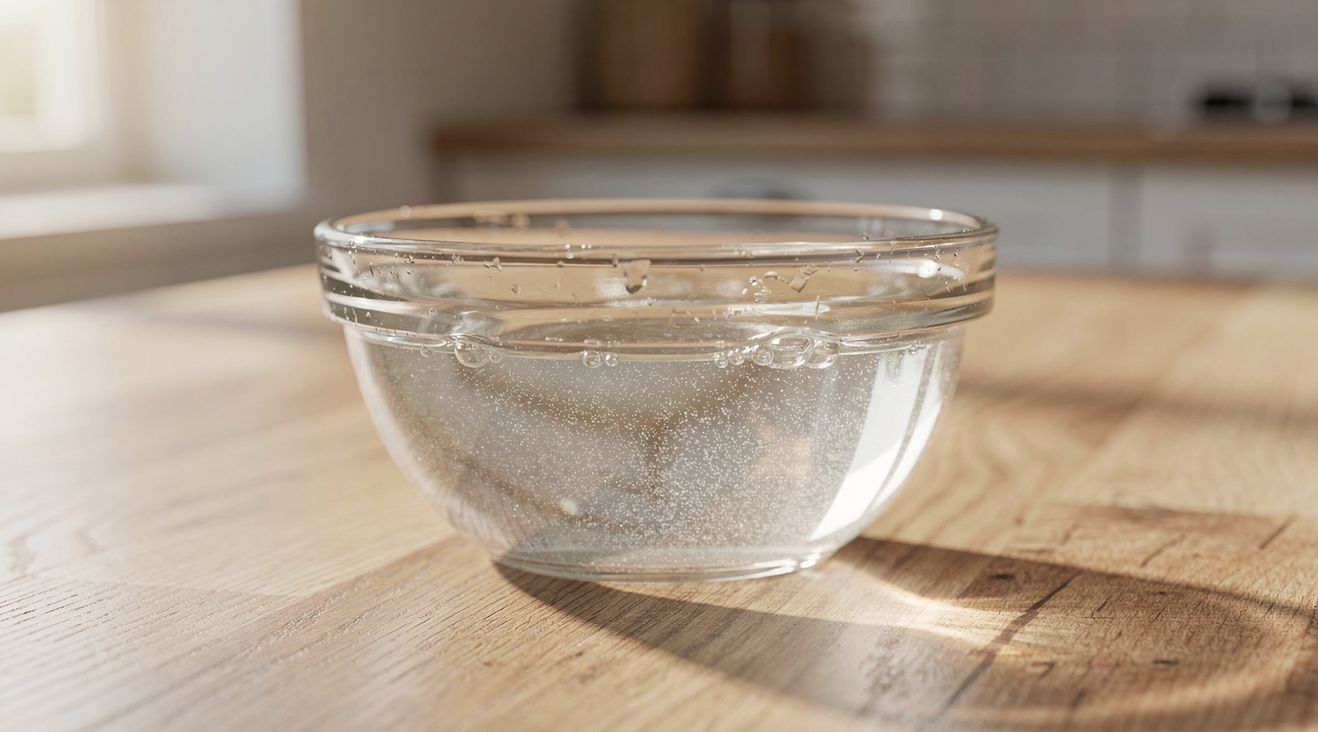

The kitchen at midnight carries a particular kind of silence. No hum from the refrigerator cycling on, no street noise filtering through closed windows. In this stillness, smells linger differently. They settle into fabrics, cling to walls, become part of the air itself. Most of us reach for air freshener or open a window, hoping the problem will solve itself by morning. But there’s a quieter alternative that has persisted for generations, passed along in kitchens and apartments as if it were a closely guarded secret: a simple bowl of white vinegar, left uncovered on the counter overnight.
By morning, something has shifted. The aggressive odor from last night’s fish or garlic pasta has softened. The staleness hanging near the trash bin seems less intrusive. The room hasn’t been transformed into a fragrant paradise, but it feels lighter, as if someone has gently turned down the volume on smells that were speaking too loudly. The mechanism is unglamorous and doesn’t require batteries, subscriptions, or brands. It requires only what most people already have in a cabinet.
This small gesture reveals something about how we live with our homes, how we manage the invisible traces of daily life, and why we might prefer a household staple over flashy commercial solutions. Understanding why vinegar works, and more importantly, how to use it without disappointment, opens a different conversation about indoor air quality and the small rituals that quietly sustain our comfort.
The quiet chemistry of acetic acid and airborne odors
The science behind this works simply, but understanding it prevents disappointment. Vinegar contains acetic acid, a molecule that interacts with certain odor-causing compounds floating in the air. Rather than masking smells with a stronger perfume, vinegar engages in a kind of chemical negotiation. Those tiny acid molecules attach to some of the volatile compounds responsible for cooking smells, pet odors, and mustiness. The result isn’t elimination but neutralization—a reduction in what your nose detects.
Consider what happens in a kitchen after frying fish. Aerosol particles and odor molecules scatter into the air and settle onto surfaces. Overnight, these compounds continue to release their scent. When acetic acid from the vinegar bowl rises into that same air, it doesn’t erase the fish smell entirely. Instead, it dampens it, making the offensive edge less pronounced. By morning, what once felt intrusive has become merely subtle, almost ignorable.
According to the Environmental Protection Agency’s guidance on indoor air quality, volatile organic compounds and odor molecules behave differently depending on temperature, humidity, and air circulation. Vinegar’s effectiveness relies on passive evaporation and molecular interaction—no fans needed, no electricity consumed. It’s why the method works best in still air, in smaller rooms, or overnight when household activity drops and air movement slows.
How to use vinegar overnight without turning your home into a salad
The practice itself demands almost no skill. Pour plain white vinegar into a small bowl, glass or ceramic, until it’s roughly halfway full. Leave it uncovered near the source of the smell—beside the trash bin, by the sink, or in the corner of a room that feels stuffy. Let it sit for at least six to eight hours, ideally overnight. In the morning, discard the vinegar, rinse the bowl, and move forward.
The stumbling block isn’t technique; it’s expectation. Many people try this once, wake up hoping their apartment will smell like a luxury hotel, and pronounce the trick worthless after discovering their home simply smells less bad rather than positively fragrant. Vinegar doesn’t perfume; it resets. It doesn’t give you a new smell so much as it takes away the old one’s aggressive edge.
Common mistakes tend toward enthusiasm. Three large bowls in a small bedroom doesn’t triple the effect—it creates a strong acidic smell that can be equally off-putting at 6 a.m. Start minimal. A single bowl in a 200-square-foot kitchen is sufficient. Also resist the urge to mix methods. Pairing vinegar with heavy synthetic fragrances creates an odd, competing scent that confuses rather than improves the air.
“Vinegar doesn’t give you a new smell,” explains one home-care professional familiar with this practice. “It gives you back the one you had before the odors moved in.”
One practical note: white distilled vinegar outperforms balsamic or cider varieties. The latter leave sticky residues and introduce food-like aromas that complicate rather than simplify the goal. The bowl should sit at counter or table height where air circulates freely, not tucked into a corner where stagnant air limits the vinegar’s reach. In the morning, crack a window briefly to clear both the old odors and any remaining vinegar notes.
What escapes the typical home-odor conversation
Nobody discusses this openly, but indoor smells carry emotional weight. They connect to shame, to questions about cleanliness, to whether your home is being managed competently. A persistent food smell or mustiness can make a person feel vaguely inadequate, even when the cause is entirely innocent—a cooking method that’s simply pungent, a basement prone to humidity, or neighbors’ smoke seeping through shared walls.
This is where the vinegar bowl’s real value hides. It’s not a miracle cure; it’s a small point of control. The gesture says: I’ve noticed, I care enough to respond, and I’m taking a deliberate action. There’s something psychologically different about leaving out a bowl deliberately than there is about spraying aerosol products reactively. One feels intentional, measured. The other feels desperate, covering something up.
What’s equally interesting is how low-tech this approach remains, despite living in an era saturated with plug-in diffusers, ultrasonic humidifiers with essential-oil compartments, and sprays promising “mountain peak” or “fresh linen” in bathrooms that haven’t seen sunlight in months. The vinegar bowl doesn’t sell a fantasy. It slightly improves reality. It respects the complexity of a real home while offering a modest, honest solution.
Many people don’t use this daily. They reach for it when something has crossed a line—after cooking with aggressive spices, after pets have left a mark, when humidity has allowed staleness to accumulate, or after hosting guests and wanting the space to feel reset by morning. It becomes a background reflex, not a commitment. Try it once after frying bacon, again after a dinner party, and slowly it becomes something you instinctively pull from your toolkit.
The practical boundaries of this household method
Honesty matters. Vinegar addresses floating odors and airborne compounds; it doesn’t clean soiled surfaces or solve structural problems. Mold growth, cigarette smoke that’s saturated walls, or pet damage to carpeting requires different interventions. Vinegar is a complement to cleaning and ventilation, not a replacement. If your kitchen smells perpetually of old grease, a bowl of vinegar buys you time and comfort, but you still need to clean the stovetop and hood vent.
Similarly, vinegar works best in still air. During the day, when doors open, windows crack, and people move through rooms, the air’s circulation disperses both the odors and the vinegar’s effect. The overnight window—those quiet hours between midnight and morning—is when air movement is minimal and the chemical interaction can happen most efficiently.
The method also works better on newer, fresher odors than on smells that have embedded themselves over weeks. A room that smelled of fish last night responds better to vinegar than a room that’s been quietly reeking of damp for two months. In the latter case, you’re addressing a symptom while the underlying cause persists.
Why people return to this trick despite having other options
In our era of premium home fragrance products and subscription air-freshening services, the persistence of the vinegar bowl speaks to something deeper than cost savings, though that matters too. Trust matters. People know what vinegar is. They know it’s safe, that it won’t introduce chemicals they can’t pronounce into their breathing space, that it won’t trigger allergies or sensitivities the way some synthetic fragrances do.
There’s also a quietness to it. No plugs, no batteries, no alerts on your phone reminding you to reorder capsules. Just a bowl sitting on the counter, doing its work invisibly. Many of us have grown weary of the noise and commercial demand built into modern solutions. The vinegar bowl feels like a decision you make once and then forget about, which is precisely the point.
The other factor is realistic outcomes. Vinegar doesn’t promise to transform your home into a showroom. It promises to reduce an unpleasant situation, and it delivers on that promise consistently. That modest honesty builds loyalty in a way that ambitious marketing claims rarely do.
There’s also something almost defiant about it, in a quiet way. In choosing a kitchen staple over a branded product, in trusting something your grandmother might have known over something designed in a corporate lab, there’s a small assertion of independence. The home belongs to you, not to the marketing department of a fragrance company. What works in your space is what matters, not what’s advertised to work.
Over time, the vinegar bowl becomes woven into how a person manages their home. Not as a daily ritual, but as a tool you reach for when the air feels heavy, when last night’s cooking has left a mark, or when you simply want to start the morning in a space that feels freshly neutral rather than lingering in yesterday’s smells. It’s one of those small, unglamorous habits that sustains comfort without demanding attention or resources, doing its work in the hours when no one’s paying attention.


